Fibromyalgia is increasingly understood as a disorder of how the nervous system processes pain rather than a disease of the muscles themselves. Upper cervical chiropractic does not cure fibromyalgia, and no one should claim it does. What it offers Berks County patients is a way to address one correctable structural stressor sitting directly beside the brainstem that helps regulate pain.
Why fibromyalgia behaves like a nervous-system problem rather than a muscle problem — and where upper cervical care fits — from the doctors at Keystone Specific Chiropractic Center in Wyomissing, PA.
If you have fibromyalgia, you have almost certainly been told that your bloodwork is normal, your imaging is unremarkable, and there is nothing structurally wrong with you. That message is meant to be reassuring. Usually it lands as dismissal. This guide walks through what the current understanding of fibromyalgia actually says, why the upper neck keeps coming up in that conversation, and how Keystone Specific approaches a fibromyalgia patient — including the honest limits of what upper cervical care can and cannot promise.
What Fibromyalgia Actually Is
Fibromyalgia is a chronic condition defined by widespread musculoskeletal pain, fatigue, sleep disruption, and cognitive difficulty, in the absence of the tissue damage that would normally explain that much pain. It is common, it is real, and it is measurable in how the nervous system behaves.
It is also widespread. According to the U.S. Office on Women's Health, fibromyalgia affects as many as 4 million Americans 18 and older — a figure the agency published on its fibromyalgia topic page, last updated October 24, 2025. The National Library of Medicine's MedlinePlus describes the same picture: a condition marked by pain all over the body, along with fatigue, trouble sleeping, and problems with thinking and memory. Nothing in either description points to a muscle that is torn, a joint that is degenerated, or an organ that is failing. That absence is the whole puzzle.
Why Does Fibromyalgia Pain Persist Without an Injury?
Because in fibromyalgia the problem is not the signal being sent — it is the volume at which the nervous system receives it. The leading explanation is central sensitization: the central nervous system becomes hypersensitive and amplifies ordinary sensory input into pain.
Think of a stereo with the gain turned up too far. The music coming in is normal. What comes out is distorted and far too loud. In a sensitized nervous system, a light touch, a cool room, a normal sound, or a mildly tense muscle can be processed as genuinely painful. This is not imagination and it is not exaggeration — it is a measurable change in how pain pathways behave, which is exactly why standard imaging looks normal while the pain is entirely real. It also explains why anti-inflammatory medication so often underperforms in fibromyalgia: there is frequently no inflammation to reduce.
The Brainstem's Role in Pain Regulation
The brainstem is where much of the body's pain-dampening machinery lives, which makes it central to any conversation about a pain system that has stopped dampening properly. It houses the descending inhibitory pathways — the circuits that are supposed to quiet pain signals before they reach conscious awareness.
When those pathways work well, most of the sensory noise your body generates never becomes pain. When they work poorly, the brakes come off. Researchers studying fibromyalgia have focused heavily on exactly this loss of descending inhibition, and it is the most coherent account available of why a person can hurt everywhere with nothing visibly wrong. The practical question that follows is a structural one: is anything mechanically stressing the region where those pathways live?
How Could the Upper Cervical Spine Influence Fibromyalgia?
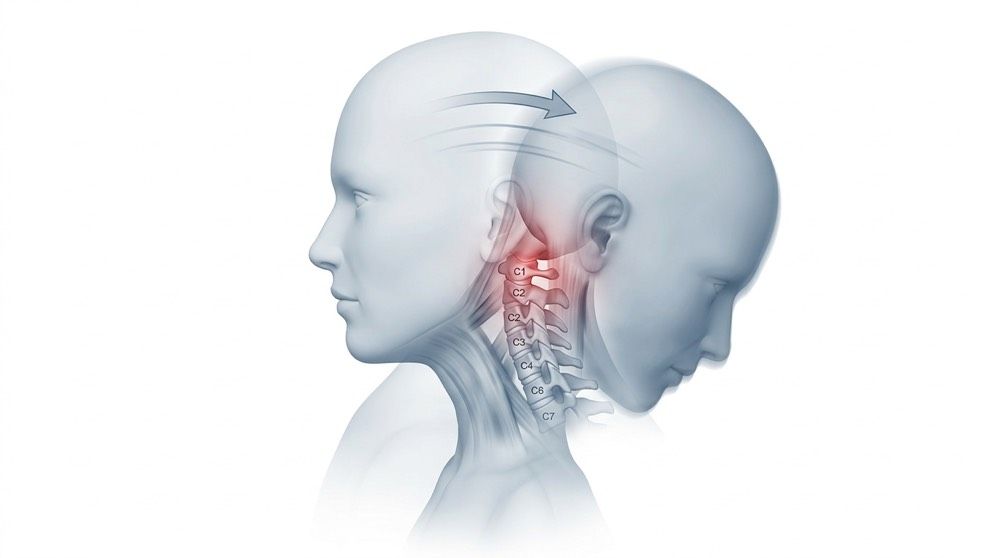
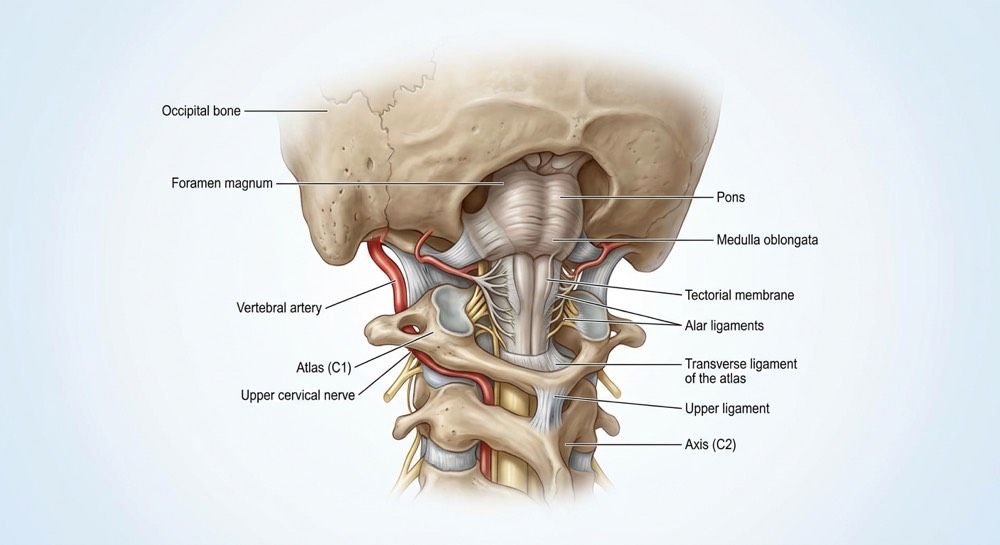
The atlas (C1) and axis (C2) sit directly around the lower brainstem and the top of the spinal cord — the precise region where pain regulation happens. A misalignment there is one of the few mechanical stressors that can plausibly reach those structures.
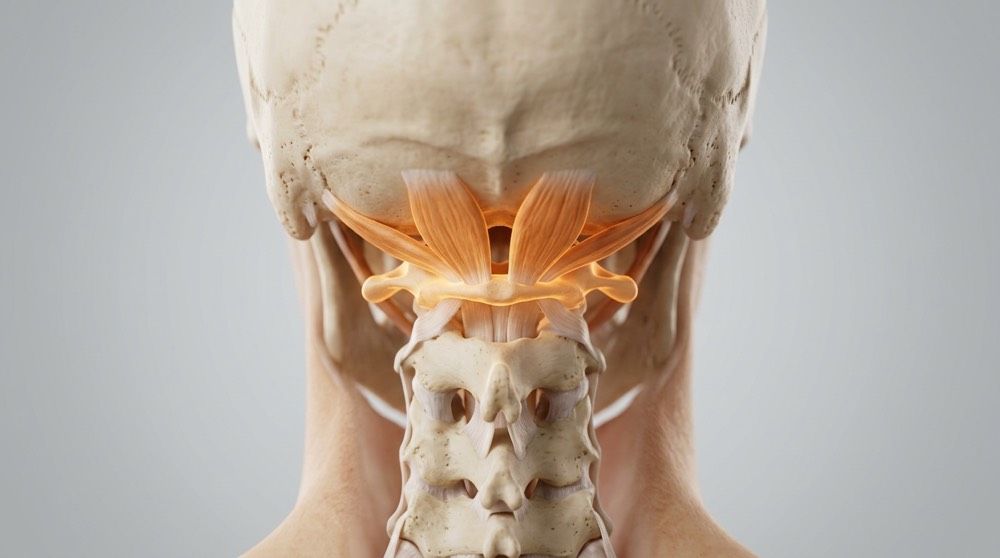
This is a matter of position, not theory. The brainstem passes through the opening in the atlas, and no other vertebra in the body has that relationship. Our overview of the atlas and axis explains why two small bones carry such outsized influence. When the atlas shifts out of position, it can irritate the surrounding tissue, alter the mechanics of the junction, and lock the suboccipital muscles into chronic guarding. For a nervous system that is already amplifying everything, an ongoing local stressor in that specific location is not a trivial detail. Whether it is a cause of sensitization or an aggravator of it will vary by patient — and honest care says so rather than choosing the more flattering answer. That refusal to overstate is the reason we practice specific chiropractic rather than general adjusting.
What the Evidence Does and Does Not Show
The evidence for upper cervical chiropractic in fibromyalgia is limited. It consists largely of case reports and small studies, not the large randomized trials that would let anyone call this approach proven or evidence-based for fibromyalgia. Our doctors do not describe it that way, and neither does this practice.
What is well established is the underlying neurology: the brainstem's role in pain modulation is not in dispute, and the anatomical relationship between the atlas and the brainstem is a matter of ordinary anatomy. What has not been established is that correcting the atlas reliably reduces fibromyalgia symptoms across a broad population. That gap matters, and patients deserve to hear it stated plainly. The reasonable position is that upper cervical care is a conservative, low-force, non-invasive option worth evaluating — not a treatment that should replace the medical care you already have, and not something anyone should promise results from.
How Keystone Specific Evaluates a Fibromyalgia Patient
Evaluation comes before any correction, and for a fibromyalgia patient the evaluation itself is often the most clarifying part. The goal is a simple, answerable question: is there an atlas misalignment present, and is the nervous system showing measurable stress?
Two objective tools answer it. Precise digital X-rays map the position and angle of the atlas, which is what determines whether a correction is warranted and in what direction. A Tytron digital infrared scan reads the heat pattern along the spine, where asymmetries serve as a marker of nervous-system interference. The scan is painless and takes minutes — which matters when the patient in the chair is sensitive to almost everything. This measure-first discipline is the foundation of our approach to care, and it is also the reason a fibromyalgia patient may be told that upper cervical care is not indicated for them. If the data does not support a correction, no correction is recommended.
What Does Care Actually Look Like Week to Week?
Slower than most patients expect, and that is the honest answer. Where a headache patient may notice change quickly, a sensitized nervous system that has been amplifying pain for years does not reset in a visit or two.
The correction itself is gentle — a light, specific contact calculated from your own images, with no twisting, no thrust, and no cracking. If you want to see how one of these corrections is performed, our explainer on what upper cervical chiropractic care is walks through the mechanics. After the correction, patients rest so the nervous system can begin re-patterning, and a follow-up scan confirms whether the change held. Progress in fibromyalgia is tracked in weeks and months, not days, and it is tracked against the scan rather than against a good afternoon. Some patients report meaningful reductions in pain intensity, better sleep, and less cognitive fog over a course of care. Others do not. Both outcomes are reported here as they occur, and the patient accounts on our success stories page should be read as individual experiences rather than expected results.
Fibromyalgia, Sleep, and the Stress Response
Sleep disruption and a stuck stress response are not side effects of fibromyalgia — they are part of the machinery that sustains it, which is why they belong in the care plan rather than at the end of it. Poor sleep lowers pain tolerance, and elevated pain wrecks sleep, and the loop tightens from both directions.
The autonomic nervous system sits in the middle of that loop, and it is regulated from the same brainstem region the upper cervical spine surrounds. Patients often find it useful to read how structural care relates to nervous-system regulation in our post on anxiety and the nervous system. In practice, this means your doctor will ask about your sleep, your stress load, and your daily rhythms — not as a formality, but because the structural correction works alongside those factors rather than instead of them.
Who Should and Should Not Consider an Evaluation
An upper cervical evaluation makes the most sense for a fibromyalgia patient with a history of head or neck trauma, persistent upper-neck symptoms, or a long record of treatments that have not helped. It makes less sense as a first move for someone whose fibromyalgia is newly diagnosed and not yet worked up medically.
A typical Keystone Specific patient in this category is someone from Wyomissing, Reading, or Shillington who was diagnosed years ago, cycled through medications and specialists, and was eventually told to manage it. Often there is an old car accident, a fall, or a sports concussion in the history that nobody connected to anything. That history is worth examining. Upper cervical care is designed to work alongside your rheumatologist and primary care physician, never as a replacement for them, and never as a reason to change a prescription. It is one more structural question, asked carefully, about a condition that has been short on structural answers.
Frequently Asked Questions
Is fibromyalgia caused by a problem in the neck?
No — fibromyalgia does not have a single established cause, and the neck is not it. Current understanding points to central sensitization, a change in how the nervous system processes pain. The upper cervical spine is relevant because it sits beside the brainstem structures involved in that processing, so a misalignment there may act as one contributing stressor among several.
Will an upper cervical adjustment flare my fibromyalgia symptoms?
Some patients do feel temporarily more tender or tired in the days after a correction as the nervous system adapts, and that possibility is discussed up front. Upper cervical corrections are low-force and specific, with no twisting or forceful manipulation, which is why they are often tolerated by people who cannot manage general adjusting. Tell your doctor immediately if symptoms intensify.
Can upper cervical care help fibromyalgia fatigue and brain fog, not just pain?
Some patients report improvements in energy and mental clarity alongside changes in pain, which is consistent with the idea that all three trace back to nervous-system regulation. These reports are individual experiences, not guaranteed outcomes, and the research base is too thin to promise them. Progress is tracked with objective scans so improvement is measured rather than assumed.
Is fibromyalgia the same condition as chronic fatigue syndrome?
They are separate diagnoses that overlap considerably. Fibromyalgia is defined primarily by widespread pain, while chronic fatigue syndrome centers on disabling, unrefreshing exhaustion. Many patients meet criteria for both, and both involve nervous-system dysregulation. Diagnosis belongs with your physician; an upper cervical evaluation addresses only whether a structural contributor is present.
Ask a Structural Question About a Condition Short on Answers
If fibromyalgia has left you managing symptoms with no explanation you find satisfying, an upper cervical evaluation is a low-risk way to rule one structural factor in or out. Contact Keystone Specific Chiropractic Center in Wyomissing — we measure first and recommend care only when the data supports it. Find out what your scan actually shows, or call us at (610) 741-6700 to talk it through first.
Written by Dr. Bill Moss, DC, upper cervical chiropractor and founder of Keystone Specific Chiropractic Center in Wyomissing, PA.
This article is for general educational purposes and is not a substitute for individualized medical advice or in-person evaluation. Upper cervical chiropractic is not a treatment or cure for fibromyalgia. Always coordinate care with your physician and never change a prescription without consulting the doctor who prescribed it.